MemoHoney Official Website › Ingredients
IngredientsMemoHoney ingredients: the six names on the label and the dose behind each
MemoHoney names six ingredients and carries no amount for any of them.
They are L-arginine, L-arginine AKG 2:1, L-citrulline HCL, L-citrulline malate, niacin and beta-alanine. Four are two molecules in four forms. Below, each name carries the dose its published trials used and the endpoint those trials measured, because that is the only comparison this artwork allows.
A front label, an ingredient graphic, six names and no figures. This page fills the missing column with published trial doses rather than guesses.
What the MemoHoney label actually carries
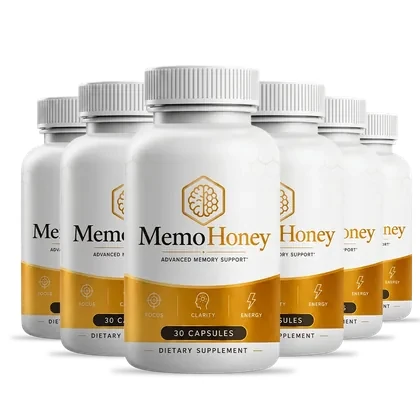
The artwork supplied with this product is a front label and an ingredient graphic. The front carries the wordmark, the line Advanced Memory Support, the three band words FOCUS, CLARITY and ENERGY, the count 30 CAPSULES, and the words DIETARY SUPPLEMENT. The ingredient graphic repeats the six names with a molecular diagram against each. Between the two there is no Supplement Facts panel, no serving-size line and no milligram figure.
This desk states that plainly once and then works with what there is. An estimate printed beside a real trial dose reads like a real figure, and that is worse than an honest blank.
Six names: L-Arginine, L-Arginine AKG 2:1 Extract, L-Citrulline HCL, L-Citrulline Malate, Niacin (Vitamin B3), Beta-Alanine. One count: 30 capsules. One claim register: Advanced Memory Support, Focus, Clarity, Energy. One direction: one capsule daily with a glass of water, preferably in the morning before a meal.
The six MemoHoney ingredients, one at a time
Each card carries the ingredient, its form, the dose the published trials used, and what those trials were measuring when they used it.
L-Arginine
a conditionally essential amino acidTrials used 6–9 g a day in the blood pressure workArginine is the amino acid nitric oxide is made from, which is why it opens this list and why it appears twice on it. Swallowed on its own it has an awkward problem: a large share of an oral dose is broken down in the gut wall and the liver before it reaches the bloodstream, so plasma arginine rises less than the label on the tub suggests.
the 2026 arginine blood pressure meta-analysis pooled five randomised trials in 202 people using ambulatory monitoring and found 24-hour systolic pressure fell by about 4.2 mmHg and diastolic by about 3.0. That is a real effect and it is a blood pressure effect. The doses behind it run 6 to 9 grams a day.
Its safety file is worth knowing. the VINTAGE MI trial gave 3 grams three times a day, 9 grams daily, to people recovering from a heart attack, for six months. The trial was stopped: arginine did not improve vascular stiffness and more deaths occurred in the arginine group. The authors concluded it should not be recommended after a myocardial infarction. That finding is about a specific population at a pharmacological dose, and it is the reason anyone with heart disease should raise this capsule with their prescriber rather than assume an amino acid is inert.
L-Arginine AKG 2:1 Extract
arginine bound to alpha-ketoglutarateTrials used 3 g acute, 10–12 g a day in the week-long studiesArginine bound to alpha-ketoglutarate at two parts to one. The pairing came out of the sports supplement market on the theory that the ketoglutarate half improves how much arginine survives to the bloodstream. Three human trials speak to it and all three measured the body, not the mind.
the AAKG performance trial gave 3,000 mg acutely before resistance exercise and found no improvement in muscular performance in either trained or untrained men. the seven-day AAKG blood flow study ran 12 grams a day for seven days and measured blood flow, plasma arginine, nitric oxide metabolites and asymmetric dimethylarginine after resistance exercise. the AAKG and HMB jump trial used 10 grams a day alongside 7.5 grams of HMB in young track and field athletes, and reported that the combination helped prevent a decline in jump performance across a training block.
Three grams acute, ten to twelve grams daily, and the endpoints are jump height, endurance and forearm blood flow. Nothing in that literature measures recall, attention or processing speed.
L-Citrulline HCL
the free amino acid, salt formTrials used 3 g twice a dayCitrulline is the better way to raise arginine, and that is not marketing. It bypasses the gut and liver breakdown that limits oral arginine, then the kidney converts it. the citrulline pharmacokinetic study is the study that established it: oral L-citrulline raised the area under the curve and peak plasma arginine in a dose-dependent way, and the highest arm, 3 grams twice a day, also lifted the trough concentration.
That makes the two citrulline rows the best-argued ingredients on this label. It also sets the scale: 6 grams a day, split, to move the marker the whole formula depends on.
the citrulline blood pressure review pooled citrulline supplementation and watermelon intake in middle-aged and older adults and found blood pressure came down overall. Again a vascular endpoint, again at gram-scale doses, and again not a memory endpoint.
L-Citrulline Malate
citrulline bound to malic acidTrials used 6–12 g acute, 8–12 g a day for six weeksThe same amino acid bound to malic acid, which is the form the sports market standardised on. Whether the malate half adds anything has now been tested directly. the citrulline-versus-citrulline-malate trial gave 43 trained adults a placebo, 5.3 grams of citrulline, or 5.3 grams of citrulline with 2.7 grams of malate, 45 minutes before testing. Neither arm improved maximal neuromuscular performance, ballistic strength or strength endurance. The malate added nothing, and neither form added anything.
the six-week resistance training trial went longer, six weeks of 8 grams of L-citrulline or 12 grams of citrulline malate a day alongside resistance training. the flow-mediated dilation study tested 6 and 12 grams acutely against flow-mediated dilation in healthy young men: both doses raised serum citrulline, arginine and ornithine, and neither improved dilation. It also raised asymmetric and symmetric dimethylarginine, which are the molecules that inhibit nitric oxide synthase.
the 2026 citrulline malate meta-analysis is the current summary: thirty randomised trials, 644 participants, a small overall effect on exercise performance of g = 0.16, wide prediction intervals, and GRADE certainty rated low to very low. Reliable dosing and target populations, in the authors' own words, have not been established.
Niacin (Vitamin B3)
nicotinic acid, a water-soluble vitaminTrials used dietary intake in a 3,718-person cohort; 2 g a day in the lipid trialsThe only ingredient on this label with a published line to cognition, and the only one that works at a dose a capsule can carry. Niacin is a precursor to NAD and NADP, the coenzymes almost every cell uses to move electrons around, and severe deficiency produces pellagra, whose third classical symptom is dementia. a 2026 pellagra case report is a recent reminder that the cognitive part of that picture reverses when the vitamin is replaced.
the Chicago dietary niacin cohort is the cohort everyone cites. Among 3,718 Chicago residents with dietary data and repeated cognitive testing, people in the upper quintiles of total niacin intake had roughly a third of the risk of incident Alzheimer's disease of the lowest quintile, and food niacin tracked a slower annual rate of decline. It is observational, it is about diet rather than capsules, and it cannot show that adding niacin to an already adequate intake helps anyone.
Two things bound the enthusiasm. the HPS2-THRIVE safety report put 25,673 high-risk patients on extended-release niacin at 2 grams a day with laropiprant and found excess myopathy and liver signals; that is a pharmacological dose, far above anything a memory capsule carries, but it is why niacin is a vitamin with a safety file. And the 2024 niacin metabolite paper reported in Nature Medicine that 4PY, a terminal breakdown product of niacin, promotes vascular inflammation and tracks cardiovascular risk. Neither finding applies at dietary amounts. Both are reasons to know how much you are taking, which this label cannot tell you.
Beta-Alanine
a non-proteinogenic amino acidTrials used 4–6.4 g a day for four weeks or moreBeta-alanine is the rate-limiting half of carnosine, the dipeptide muscle uses to buffer acid during hard effort. the ISSN position stand on beta-alanine, the International Society of Sports Nutrition position stand, sets the effective protocol at 4 to 6 grams a day for at least four weeks and notes that the only commonly reported side effect is paraesthesia, the tingling that follows a large single dose, which divided 1.6-gram doses or a sustained-release form reduce.
the two-protocol carnosine loading study compared 6 grams a day for four weeks against 12 grams a day for two and measured the muscle carnosine each produced. the four-week kickboxing trial ran 6.4 grams a day for four weeks in trained kickboxers. the beta-alanine risk assessment is the systematic risk assessment, and it concluded that supplementation within the doses used in the available research is not associated with harm.
Every one of those endpoints is muscular. There is no human trial of beta-alanine for memory. The nearest thing in its family is the NEAT carnosine trial, which gave 2 grams of carnosine itself daily for up to twelve weeks and found a cognitive benefit restricted to the younger half of the sample. Different molecule, different dose, and a result that does not transfer.
Honest label analysis: the MemoHoney amounts against the trial amounts
A size 0 capsule, which is the size this bottle is filled with, holds roughly 0.5 to 0.9 grams of blended powder. The five non-vitamin ingredients on this label were tested at 3 to 12 grams a day each. One capsule a day cannot deliver a trial dose of any of them, let alone all five, and no arrangement of six ingredients inside one capsule changes that.
Read down the right-hand column and one thing stands out. Five of the six entries are exercise or blood-pressure endpoints at gram-scale doses. The sixth is a dietary cohort. Nowhere in that column is there a randomised trial of a capsule, at a capsule dose, measuring memory.
That is not a hidden fact this desk uncovered. It is what the literature on these six ingredients consists of, and any honest reading of the label arrives at it. What a buyer does with it is a separate question, and the benefits page takes the seller's five support lines one at a time.
The four botanicals in the MemoHoney photograph that are not in the capsule
The seller's main product shot stands the bottle among ginkgo leaves, a lion's mane mushroom, blueberries and rosemary. All four are famous memory-shelf names. None is an ingredient.
It matters because two of them, ginkgo and lion's mane, have their own research literatures and their own reputations, and a shopper who registers them in the image will carry that reputation onto this bottle. The capsule contains the six names above and nothing else that the artwork declares.
Set dressing is normal in product photography and this is a well-made photograph. Saying so out loud is the part a retail desk can add.
If you are choosing between this and a ginkgo or lion's mane capsule, you are not choosing between two versions of the same idea. You are choosing between vascular chemistry and plant chemistry, and the photograph on this bottle does not make it the second one.
What is missing from the MemoHoney formula for the claim it makes
A useful way to judge a memory capsule is to ask which of the ingredients with the strongest cognitive literature it chose to leave out. On this label that list is long: no B12, no folate, no omega-3, no citicoline, no bacopa, no phosphatidylserine, no creatine. Several of those are cheap.
The absence of a famous name is not a fault on its own. A formula that picked vascular support deliberately, and said so, would be a defensible formula. What makes this one hard to defend is that the front of the bottle promises memory and the back offers a blood-flow stack without ever explaining the connection.
the AHRQ review of over-the-counter supplements is worth holding beside that. Reviewing the whole over-the-counter shelf for the Agency for Healthcare Research and Quality, it found the evidence insufficient to recommend any supplement for preventing cognitive decline. That verdict does not single this bottle out. It does mean the missing names would not have rescued it either.
Sources behind this MemoHoney ingredients page
- Schwedhelm E, Maas R, Freese R, et al. Pharmacokinetic and pharmacodynamic properties of oral L-citrulline and L-arginine: impact on nitric oxide metabolism. Br J Clin Pharmacol. 2008;65(1):51-9. PMID 17662090. https://pubmed.ncbi.nlm.nih.gov/17662090/
- Wang X, Fan X, Chang J, et al. Effects of Citrulline Malate Supplementation on Exercise Performance: A Systematic Review and Three-Level Meta-Analysis. Nutrients. 2026;18(12). PMID 42356270. https://pubmed.ncbi.nlm.nih.gov/42356270/
- Martín-Olmedo JJ, Miras-Moreno S, Cuadra-Montes K, et al. Malate or Not? Acute Effects of L-Citrulline Versus Citrulline Malate on Neuromuscular Performance in Young, Trained Adults: A Randomized, Double-Blind, Placebo-Controlled Crossover Trial. Int J Sport Nutr Exerc Metab. 2025;35(2):89-98. PMID 39662304. https://pubmed.ncbi.nlm.nih.gov/39662304/
- Bayat D, Azizi M, Behpour N, et al. Changes in resistance training performance, rating of perceived exertion, and blood biomarkers after six weeks of supplementation with L-citrulline vs. L-citrulline DL-malate in resistance-trained men: a double-blind placebo-controlled trial. J Int Soc Sports Nutr. 2025;22(1):2513944. PMID 40470618. https://pubmed.ncbi.nlm.nih.gov/40470618/
- Grannes J, Callender NA, Gonzalez AM, et al. Acute effect of citrulline malate on flow-mediated dilation and serum pharmacodynamics in healthy young males. Front Physiol. 2026;17:1773582. PMID 41867246. https://pubmed.ncbi.nlm.nih.gov/41867246/
- Luo P, Chen J, Liu K, et al. Does l-citrulline supplementation and watermelon intake reduce blood pressure in middle-aged and older adults? A systematic review and meta-analysis of randomized controlled trials. Clin Nutr ESPEN. 2025;69:653-664. PMID 40789388. https://pubmed.ncbi.nlm.nih.gov/40789388/
- Shi Y, Liu Y, Zhou Z, et al. Reassessment of the effect of oral l-arginine on blood pressure: A systematic review and meta-analysis based on ambulatory blood pressure monitoring. Nitric Oxide. 2026;164:60-68. PMID 42520885. https://pubmed.ncbi.nlm.nih.gov/42520885/
- Schulman SP, Becker LC, Kass DA, et al. L-arginine therapy in acute myocardial infarction: the Vascular Interaction With Age in Myocardial Infarction (VINTAGE MI) randomized clinical trial. JAMA. 2006;295(1):58-64. PMID 16391217. https://pubmed.ncbi.nlm.nih.gov/16391217/
- Wax B, Kavazis AN, Webb HE, et al. Acute L-arginine alpha ketoglutarate supplementation fails to improve muscular performance in resistance trained and untrained men. J Int Soc Sports Nutr. 2012;9(1):17. PMID 22510253. https://pubmed.ncbi.nlm.nih.gov/22510253/
- Willoughby DS, Boucher T, Reid J, et al. Effects of 7 days of arginine-alpha-ketoglutarate supplementation on blood flow, plasma L-arginine, nitric oxide metabolites, and asymmetric dimethyl arginine after resistance exercise. Int J Sport Nutr Exerc Metab. 2011;21(4):291-9. PMID 21813912. https://pubmed.ncbi.nlm.nih.gov/21813912/
- Kaczka P, Kubicka K, Batra A, et al. Effects of Co-Ingestion of β-Hydroxy-β-Methylbutyrate and L-Arginine α-Ketoglutarate on Jump Performance in Young Track and Field Athletes. Nutrients. 2021;13(4). PMID 33805883. https://pubmed.ncbi.nlm.nih.gov/33805883/
- Morris MC, Evans DA, Bienias JL, et al. Dietary niacin and the risk of incident Alzheimer's disease and of cognitive decline. J Neurol Neurosurg Psychiatry. 2004;75(8):1093-9. PMID 15258207. https://pubmed.ncbi.nlm.nih.gov/15258207/
- HPS2-THRIVE Collaborative Group. HPS2-THRIVE randomized placebo-controlled trial in 25 673 high-risk patients of ER niacin/laropiprant: trial design, pre-specified muscle and liver outcomes, and reasons for stopping study treatment. Eur Heart J. 2013;34(17):1279-91. PMID 23444397. https://pubmed.ncbi.nlm.nih.gov/23444397/
- Ferrell M, Wang Z, Anderson JT, et al. A terminal metabolite of niacin promotes vascular inflammation and contributes to cardiovascular disease risk. Nat Med. 2024;30(2):424-434. PMID 38374343. https://pubmed.ncbi.nlm.nih.gov/38374343/
- Ramos D, Valente A, Leão R, et al. Marchiafava-Bignami Disease and Pellagra in a Chronic Alcohol User: A Reversible Case of Cognitive Impairment. Cureus. 2026;18(1):e102149. PMID 41732620. https://pubmed.ncbi.nlm.nih.gov/41732620/
- Trexler ET, Smith-Ryan AE, Stout JR, et al. International society of sports nutrition position stand: Beta-Alanine. J Int Soc Sports Nutr. 2015;12:30. PMID 26175657. https://pubmed.ncbi.nlm.nih.gov/26175657/
- Dolan E, Swinton PA, Painelli VS, et al. A Systematic Risk Assessment and Meta-Analysis on the Use of Oral β-Alanine Supplementation. Adv Nutr. 2019;10(3):452-463. PMID 30980076. https://pubmed.ncbi.nlm.nih.gov/30980076/
- Church DD, Hoffman JR, Varanoske AN, et al. Comparison of Two β-Alanine Dosing Protocols on Muscle Carnosine Elevations. J Am Coll Nutr. 2017;36(8):608-616. PMID 28910200. https://pubmed.ncbi.nlm.nih.gov/28910200/
- Küçük FH, Gençoğlu C, Ateş O, et al. Effects of β-alanine supplementation on kickboxing-specific anaerobic performance, neuromuscular power, and strength endurance: A randomized, double-blind, placebo-controlled trial. PLoS One. 2026;21(5):e0346898. PMID 42127019. https://pubmed.ncbi.nlm.nih.gov/42127019/
- O'Toole TE, Amraotkar AR, Gao H, et al. Carnosine supplementation improves cognitive outcomes in younger participants of the NEAT trial. Neurotherapeutics. 2025;22(2):e00541. PMID 39919936. https://pubmed.ncbi.nlm.nih.gov/39919936/
- Butler M, Nelson VA, Davila H, et al. Over-the-Counter Supplement Interventions to Prevent Cognitive Decline, Mild Cognitive Impairment, and Clinical Alzheimer-Type Dementia: A Systematic Review. Ann Intern Med. 2018;168(1):52-62. PMID 29255909. https://pubmed.ncbi.nlm.nih.gov/29255909/
Order MemoHoney knowing exactly what the label says
Six names, no amounts, and a published trial dose printed beside each one. That is the full picture available on this bottle, and it is the picture this desk sells against.
Two bottles $158 · six bottles $294 · 60-day money-back guarantee
Order MemoHoney On The Official WebsiteOne capsule a day · 30 per bottle · lot MEM-26/ME-1451